Why Farmers Are More Important Than Teachers: Top Debate Points & Perspectives
Good morning/afternoon, esteemed judges, fellow debaters, and honored guests.
Let’s start with a stark truth: Humanity is always just three days away from chaos. Three days without food, and the intricate fabric of our society begins to unravel. This chilling reality underscores a fundamental truth we often overlook: while education enriches the mind, agriculture sustains the body. Without the farmer, the teacher has no student to teach.
Today, we argue that farmers are, in fact, more important than teachers. This isn’t a dismissal of the noble profession of teaching, but a recognition of the foundational role that agriculture plays in human existence. We contend that the farmer provides the very lifeblood that makes all other societal advancements, including education, possible. Our arguments will delve into biological necessity, economic impact, and their crucial role as stewards of our planet.
Why Farmers are More Important Than Teachers: Top Debate Points
In the hierarchy of human survival, two professions often stand at the top: the farmer and the teacher.
While teachers cultivate the mind, farmers cultivate the earth. But if we are forced to choose the most essential, the scale tips toward the farmer.
Below is a detailed breakdown of the debate points that prove why agriculture is the ultimate foundation of society.
The 2-Minute Opening Speech
(Use this as a script for a formal debate)
“Good morning, esteemed judges, fellow debaters, and guests.
There is an old proverb that says: ‘Once in your life you need a doctor, a lawyer, a policeman, and a preacher, but every day, three times a day, you need a farmer.’ Today, we argue that farmers are more important than teachers. This is not to diminish the noble work of educators, but to acknowledge a biological reality. While a teacher provides the tools for a better quality of life, a farmer provides the existence of life itself.
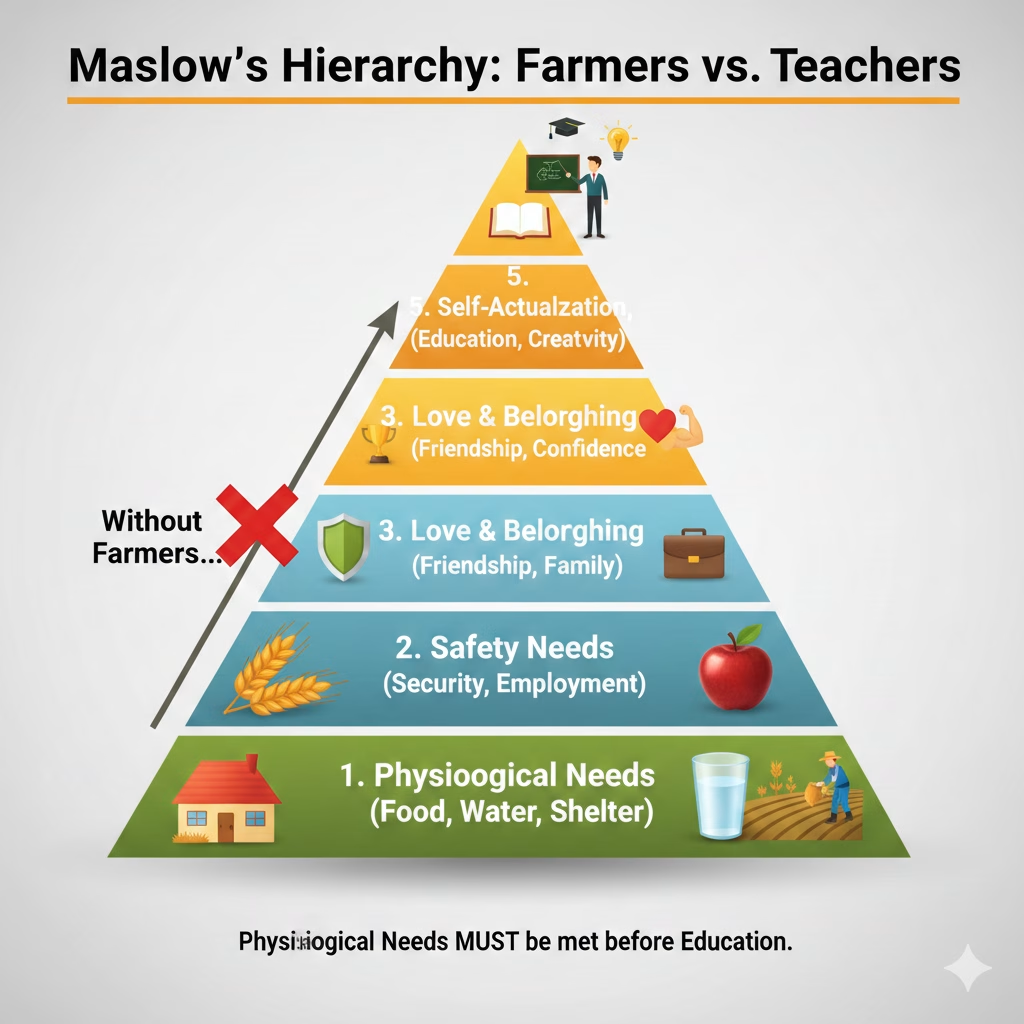
According to Maslow’s Hierarchy of Needs, physiological requirements like food and water are the base of the pyramid. Education sits at the top under ‘self-actualization.’ You cannot teach a starving child. You cannot run a university in a famine. The teacher’s classroom only exists because a farmer produced a surplus of food, allowing society to move beyond mere survival.
Farmers are the primary engines of the economy, the guardians of our environment, and the silent providers for every living soul on this planet. Without the farmer, the teacher has no student to teach, no desk to sit at, and no life to enrich. Therefore, the farmer is not just ‘as important’, they are the prerequisite for civilization.
1. Biological Necessity vs. Intellectual Development
At the core of human existence lies a universal truth: we must eat to live. This isn’t a philosophical debate; it’s a biological imperative. Consider Maslow’s Hierarchy of Needs, a cornerstone of psychology. Before any individual can contemplate self-actualization, before they can even aspire to learn, their most basic physiological needs; food, water, shelter, must be met. It is the farmer who directly addresses the most fundamental of these: food.
You can live a long and fulfilling life without ever learning to read or write; history is replete with examples of thriving oral cultures. But you cannot survive for more than a few weeks without the sustenance that only a farmer provides. The teacher ignites the mind, but the farmer keeps the flame of life burning. Without the farmer, the classroom doors remain empty, and the pursuit of knowledge becomes a meaningless luxury. The very act of thinking, learning, and teaching requires a nourished brain, powered by the efforts of the agricultural sector.
Read now: How to Use AI to Solve WAEC Past Questions: The 2026 Student Guide
Imagine this: if food supplies stop today, chaos will begin in just three days. This idea is often called the “Rule of Three Days.” Without food, societies break down very quickly.
This powerful truth helps us understand an important debate topic:
Who is more important; farmers or teachers?
Teachers educate the mind and shape the future, but farmers keep people alive today. A hungry child cannot sit in a classroom, listen, or learn. In simple terms, without the farmer, the teacher has no student to teach.
This article explains the importance of farmers vs teachers debate, focusing on why farmers can be argued to be more important for human survival.
Survival Is Not Optional
Books feed the mind, but food feeds the body.
And without the body being alive and healthy, the mind cannot function.
This shows that farmers meet the most urgent human need, survival.
Economic Impact and Global Stability
Farmers Power the Economy
Agriculture is known as the Primary Sector of the economy. This means it comes first.
-
Primary Sector: Farming, fishing, mining
-
Secondary Sector: Factories and manufacturing
-
Tertiary Sector: Services like teaching, banking, and healthcare
Without farming, there would be:
-
No raw materials for factories
-
No food for workers
-
No stable economy
Simply put, all other jobs depend on farmers.
See also: Day School vs Boarding School: A Balanced Speech on Which Is Better
Food Security Prevents Chaos
When food is scarce, countries experience:
-
Hunger
-
Riots
-
Wars
-
Political instability
Farmers help prevent these problems by ensuring food security. A nation that can feed its people is stronger and more peaceful.
Comparison Table
| Feature | Farmers | Teachers |
|---|---|---|
| Urgency | Immediate (daily survival) | Long-term (career growth) |
| Output | Tangible goods (food, fiber) | Intangible skills (knowledge) |
| Universality | Every human must eat | Not everyone attends school |
This table clearly shows why farmers are often considered more critical in emergencies and daily life.
Innovation and Environmental Stewardship
Farming Is Not Unskilled Work
Many people believe farming is simple, but this is not true.
Modern farmers use:
-
Science
-
Technology
-
Soil chemistry
-
Weather data
-
Agricultural machines
They work with agricultural technology (Agri-Tech), improved seeds, and smart farming methods to grow food for millions of people.
Protectors of the Earth
Farmers are also:
-
Protectors of the land
-
Managers of water resources
-
Guardians of biodiversity
They are on the frontline of climate change, dealing with droughts, floods, and changing weather patterns.
The “Silent Teacher”
Farmers teach powerful life lessons without a classroom:
-
Patience
-
Hard work
-
Discipline
-
Respect for nature
In this way, farmers are also teachers, teachers of life and survival.
Rebutting Common Counter-Arguments
“Teachers Make Farmers”
Some argue that teachers are more important because they educate farmers.
Rebuttal:
Farming existed thousands of years before schools. Early farmers learned through:
-
Observation
-
Apprenticeship
-
Experience
People farmed successfully long before formal education existed.
Read more: Smart Science: Less Competitive Courses in Nigeria with High Job Prospects (2026)
“Education Drives Development”
Others say education is the key to progress.
Rebuttal:
You cannot study on an empty stomach.
The brain needs glucose (energy) to function, and that energy comes from food. Without farmers, students cannot concentrate, learn, or succeed.
Food enables education, not the other way around.
Conclusion: The Verdict
This debate does not mean teachers are unimportant. Teachers are essential for growth, progress, and leadership.
However, farmers provide life itself. They feed the teacher, the student, the doctor, the engineer, and the entire nation.
Without food:
-
Schools close
-
Learning stops
-
Society collapses
That is why, in this debate, farmers can be considered more important than teachers—because they make survival possible.
Final Thought
“The farmer is the only man in our economy who buys everything at retail, sells everything at wholesale, and pays the freight both ways.” — John F. Kennedy
In the end, education shapes the future, but farming keeps humanity alive.