Smart Science: Less Competitive Courses in Nigeria with High Job Prospects (2026)
Less Competitive Courses in Nigeria with High Job Prospects (2026)
In Nigeria today, choosing a science course is no longer just about prestige, it’s about strategy. For many years, students were told that success only came from studying Medicine, Engineering, or Pharmacy. But in 2026, that mindset is changing fast.
Nigeria’s economy is expanding into technology, agriculture, environmental sustainability, data, and health innovation. These growing sectors need skilled professionals, and many of them are not produced by the “big three” science courses.
What smart students are now realizing is this:
A less competitive course can lead to faster admission, less stress, and better job opportunities after graduation.
This guide focuses on science courses that are easier to get into but still offer strong job prospects, relevance, and future growth.
Decoding “Less Competitive” and “High Job Prospects”
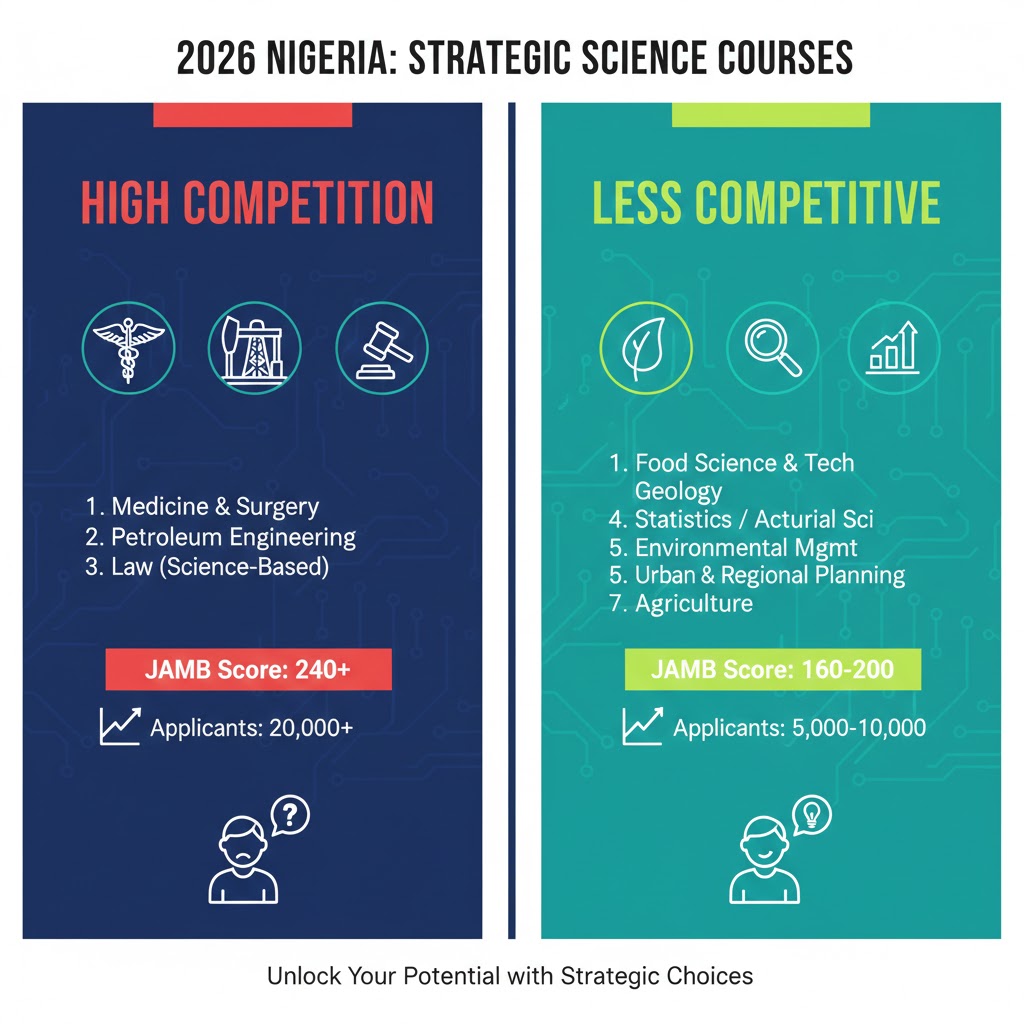
What “Less Competitive” Really Means (for JAMB & Post-UTME)
When a course is described as less competitive, it doesn’t mean it is inferior. It simply means:
-
Lower Cut-Off Marks
Most of these courses have JAMB cut-off marks between 160 and 200, unlike Medicine or Law that may require 240–300. -
Fewer Applicants
While courses like Medicine can attract 20,000+ applicants for a few hundred slots, these courses have fewer candidates, giving you a better chance of admission. -
Easier Post-UTME Screening
Many schools focus more on basic academic ability and subject relevance rather than extreme competition.
In short, less competition = higher admission success rate.
What “High Job Prospects” Means (2026 & Beyond)
A course has high job prospects when:
-
It aligns with emerging industries
Fields like renewable energy, food technology, data analysis, and environmental management are growing rapidly. -
There is a skill gap
Employers struggle to find qualified graduates, which reduces competition in the job market. -
It has global relevance
These skills are needed not only in Nigeria but also internationally, opening doors to remote work, migration, or global companies.
Read also: Best Online Universities in Nigeria Without JAMB 2026
7 Less Competitive Science Courses with High Job Prospects in Nigeria (2026)
1. Agricultural Science / Agronomy (The Green Revolution)
Why it’s smart:
Agriculture in 2026 is no longer about manual farming. Nigeria is pushing for food security, export farming, and agribusiness, and this has created massive demand for trained professionals.
Job prospects include:
-
Agronomist
-
Agricultural Consultant
-
Food Scientist
-
Soil Scientist
-
Agribusiness Manager
-
Research Officer
Typical JAMB cut-off: 160–190
Key skills you gain:
Crop science, soil management, sustainable farming, food processing, and data-driven agriculture.
2. Geology / Geophysics (The Infrastructure & Data Goldmine)
Why it’s smart:
Geology is no longer only about oil. It is essential for construction, water resources, mining, environmental studies, and urban planning. Geophysics adds a strong data and technology angle.
Job prospects include:
-
Geologist
-
Geophysicist
-
Environmental Consultant
-
Hydrologist
-
Mining Engineer
-
GIS / Geospatial Data Analyst
Typical JAMB cut-off: 170–200
Key skills you gain:
GIS, remote sensing, environmental assessment, field mapping, and data interpretation.
See now: Teachers Are Better Than Farmers: 15 Winning Debate Points & Speech Template (2026 Edition)
3. Food Science & Technology (Feeding the Future)
Why it’s smart:
Nigeria’s food and beverage industry is expanding fast. Companies need experts to ensure food safety, quality control, and product innovation.
Job prospects include:
-
Food Technologist
-
Quality Control Officer
-
Product Development Scientist
-
Food Safety Auditor
-
Nutritionist
Typical JAMB cut-off: 160–195
Key skills you gain:
Food chemistry, microbiology, quality assurance, food processing, and product formulation.
4. Statistics / Actuarial Science (The Data Powerhouses)
Why it’s smart:
Every sector now depends on data. From banks to hospitals and tech companies, statisticians and actuaries are in high demand. Actuarial Science, in particular, offers excellent earning potential.
Job prospects include:
-
Statistician
-
Data Analyst
-
Business Analyst
-
Actuary
-
Risk Manager
-
Biostatistician
Typical JAMB cut-off:
-
Statistics: 170–200
-
Actuarial Science: 190–220
Key skills you gain:
Data analysis, probability, predictive modeling, Python, R, and risk assessment.
5. Environmental Science / Environmental Management (The Green Economy Builders)
Why it’s smart:
With climate change, pollution, and sustainability challenges, Nigeria needs experts who can manage environmental risks and design sustainable solutions.
Check out: JAMB Direct Entry Requirements for Working Professionals 2026
Job prospects include:
-
Environmental Scientist
-
HSE Officer
-
Waste Management Specialist
-
Renewable Energy Consultant
-
Policy Analyst
Typical JAMB cut-off: 160–185
Key skills you gain:
Environmental impact assessment, waste management, sustainability reporting, and policy analysis.
6. Microbiology (Beyond Healthcare)
Why it’s smart:
Microbiology is essential in pharmaceuticals, food production, brewing, research, and public health. Its importance became even clearer after recent global health crises.
Job prospects include:
-
Microbiologist
-
Biotechnologist
-
Research Scientist
-
Quality Control Officer
-
Public Health Specialist
Typical JAMB cut-off: 170–200
Key skills you gain:
Laboratory techniques, molecular biology, fermentation technology, and disease surveillance.
7. Urban and Regional Planning (Shaping Modern Cities)
Why it’s smart:
Nigeria’s cities are growing rapidly. Urban planners help design sustainable cities, housing projects, and transport systems.
Job prospects include:
-
Urban Planner
-
Regional Planner
-
GIS Specialist
-
Transport Planner
-
Housing Development Officer
Typical JAMB cut-off: 160–190
Key skills you gain:
Urban design, spatial analysis, GIS, project management, and policy development.
Read more: Universities That Accept 150 JAMB Score in 2026: A Complete Guide for Students
Making Your Choice: Strategy for 2026
1. Research University-Specific Requirements
Always confirm subject combinations and cut-off marks using the JAMB brochure and school websites.
2. Look Beyond the First Degree
Many of these courses lead to high-value postgraduate options like Data Science, Environmental Management, or Biotechnology.
3. Embrace Internships & Skills
Learn practical tools early; GIS, Python, lab skills, or data software to stand out.
4. Don’t Ignore Passion
A course you enjoy will keep you motivated. Passion plus strategy leads to long-term success.
Conclusion: Your Future Is in Your Hands
In 2026, smart Nigerian students are no longer chasing prestige alone they are chasing opportunity, relevance, and sustainability.
By choosing less competitive science courses with high job prospects, you increase your chances of admission and position yourself for a secure, future-ready career.
Success is not about the most popular course, it’s about the right course for the future.


